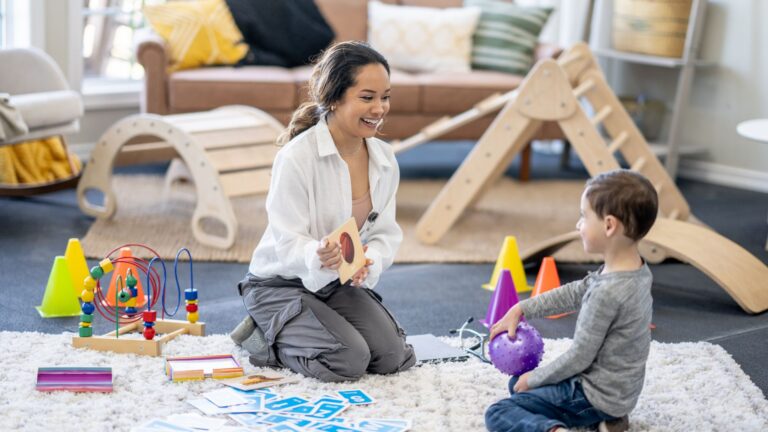



Rather than sitting through formal lectures, parents typically meet with the BCBA to discuss the child’s current goals and everyday experiences. An RBT may help demonstrate or practice strategies under appropriate supervision.
Depending on the family’s needs, parent training sessions may include:
- Reviewing progress toward treatment goals
- Discussing situations that feel challenging at home or in the community
- Practicing strategies together
- Learning how to encourage new skills during daily routines
- Identifying ways to support consistency across environments
- Asking questions and receiving guidance
These conversations are collaborative. Parents bring firsthand knowledge of their child’s daily life, personality, and interests, while the ABA team offers clinical guidance that can help make everyday routines more manageable and successful.
Examples of ABA Techniques for Parents

One goal of parent training for autism is helping caregivers feel comfortable using simple, practical strategies throughout the day so everyday interactions are more supportive and consistent.
Some common examples of ABA techniques for parents may include:
- Using positive reinforcement to encourage meaningful skills and positive behaviors
- Offering visual supports when they help clarify expectations
- Breaking larger tasks into smaller, manageable steps
- Providing simple choices that encourage participation
- Supporting communication during everyday routines
- Encouraging independence by allowing children to complete age-appropriate tasks
Focusing on positive reinforcement, clear routines, and supportive daily interactions helps children build confidence as they practice new skills.
Every family will use these strategies differently. What works well for one child may not be the best fit for another, which is why parent training for autism remains individualized throughout the ABA therapy process.
How Parent Training Helps Children Apply Skills Beyond Therapy
Children learn best when they have opportunities to practice new skills in the places where they naturally spend their time. Parent training for autism helps caregivers recognize these opportunities so children can use what they learn during therapy throughout everyday life.
For example, a child who practices waiting during therapy may also practice waiting while standing in line at the grocery store. A child learning to request help may have opportunities to use that skill while getting dressed, preparing a snack, or playing with siblings.
Research suggests that practicing skills during naturally occurring family routines supports generalization: the ability to apply learned skills across different people, places, and situations.
This doesn’t require adding extra therapy sessions at home. Instead, it means recognizing that everyday experiences can provide meaningful opportunities to practice new skills in familiar contexts.
Over time, children may become more comfortable using their skills across a wider variety of environments, helping them participate more confidently in daily life.
3 Common Misconceptions About ABA Parent Training
Many parents feel nervous when they first hear the phrase “parent training for autism.” Fortunately, many common concerns are based on misunderstandings.
1. “I’m Expected to Become a Therapist”
You are not expected to replace your child’s clinical team. Parent training provides guidance and practical tools, while therapists remain responsible for assessment, treatment planning, and clinical decision-making.
2. “I’ll Need to Do Therapy All Day”
Parent training is designed to fit naturally into routines you already have. Rather than creating hours of additional work, many strategies can be incorporated into activities such as meals, playtime, bedtime, or community outings.
3. “I’ll Be Graded on How Well I Use ABA”
Parent training for autism is not a test. It is an ongoing coaching process where caregivers can ask questions, discuss concerns, and adjust strategies together with the ABA team.
Research has shown that individualized caregiver coaching can increase parental confidence while helping reduce stress associated with supporting a child with autism.
Building a Strong Partnership with ABA Centers of Tennessee

The strongest ABA programs recognize that meaningful progress happens through partnership. Families contribute valuable insight into their child’s daily experiences, while clinicians provide evidence-based guidance tailored to the child’s individual goals.
Open communication, shared decision-making, and regular collaboration allow treatment plans to evolve as children develop new strengths and face new challenges.
Ultimately, ABA parent training is about helping families feel informed, supported, and confident. When caregivers and clinicians work together, children benefit from consistent opportunities to practice meaningful skills in the environments where they live, learn, and grow every day.
At ABA Centers of Tennessee, our team works alongside families to provide individualized coaching, answer questions, and help caregivers feel empowered throughout their child’s ABA journey.
By building strong partnerships and focusing on practical, family-centered strategies, we strive to support meaningful progress both during therapy sessions and throughout everyday life.
If you are interested in ABA therapy and parent ABA training to support your child’s progress, contact our team by calling us at (844) 423-9483 or schedule a free consultation here.